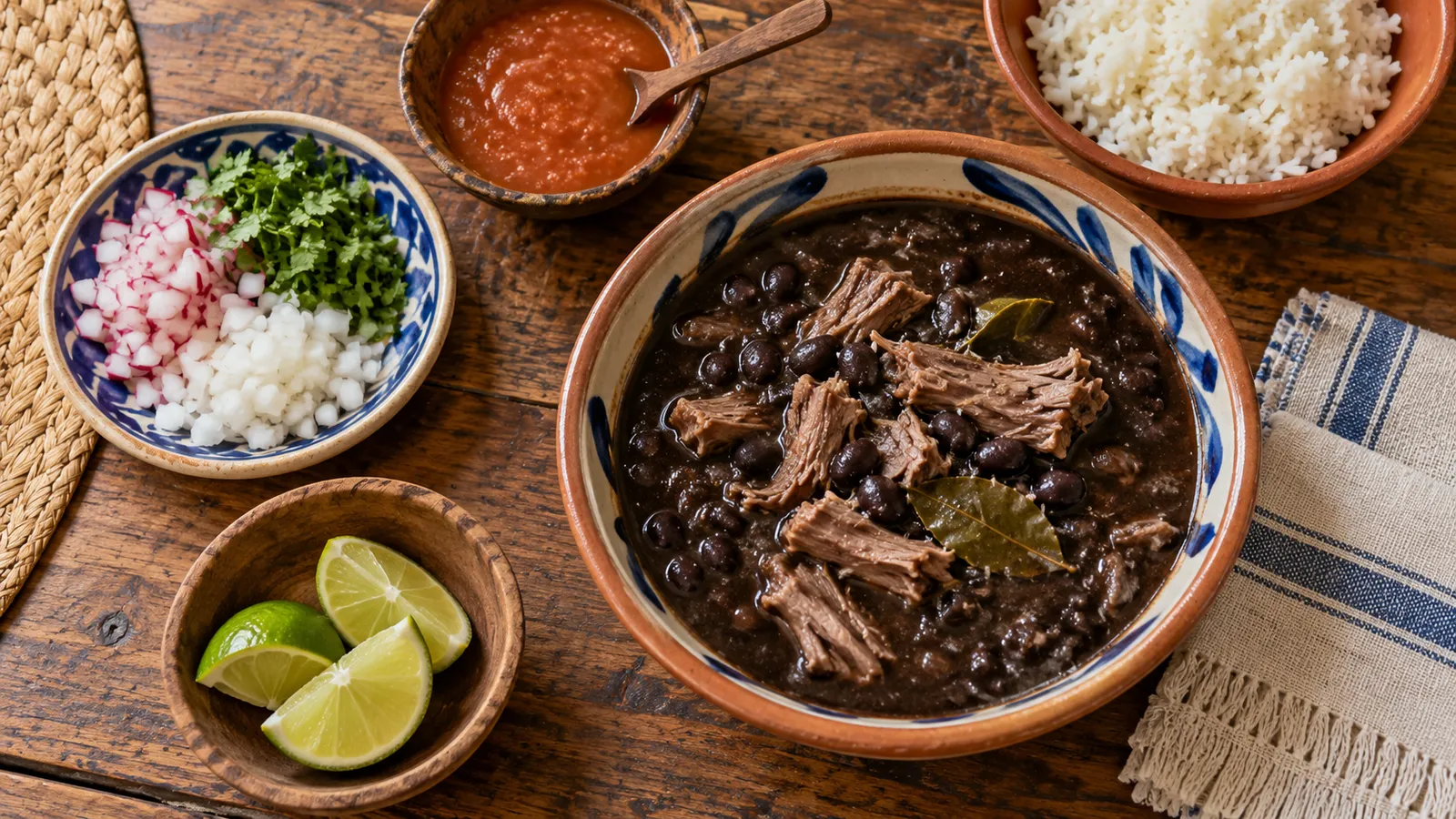
A Monday board advertising frijol con puerco has a context beyond the daily special. SEFOTUR documents the Monday association and describes black beans cooked with pork, with accompaniments such as radish, onion and cilantro. Treat the custom as a useful lunch clue rather than a guarantee that every kitchen will have the dish.
On a short stay, check the business’s current menu or ask the day before. If you live in Mérida, it can become one option in your weekday meal routine. There is no need to arrange every Monday around it or to assume that all households follow the same schedule.
Understand how this kitchen serves it
Ask whether the beans, broth and pork arrive together or whether some components come separately. Establish whether rice and tortillas are included too. The dish name and a price do not tell you how many containers or accompaniments the order contains.
If you would prefer more broth or less meat, ask before service. Adjustments depend on what has already been cooked. Ordering just the beans from the same pot will not make them vegetarian if they were prepared with pork.
Build your bowl gradually
A table of small accompaniments can make it tempting to add everything at once. Start with a spoonful of the stew, then try the radish, herbs, onion or salsa according to your taste. It helps you discover the combination you enjoy without letting a large splash of sauce take over the whole bowl.
Ask which salsa contains chile and whether an alternative is available. Tomato sauce may contain chile even when no pieces are visible. Keep a serving utensil with each shared dish and allow everyone to decide how much to add. These are practical choices for your table, rather than a compulsory order in which to eat the dish.
Taking lunch home changes the conversation
Have the seller identify the broth container, rice and accompaniments. Check that the lids close properly and that you can carry them without tilting. Ask for the business’s storage instructions and plan collection reasonably close to the time you will eat.
For a group, explain whether this is the only dish or part of a larger meal. “Somos cuatro y también habrá otra comida” tells the seller that four people will be eating but another dish is also planned. That is more useful than ordering four unknown-sized portions.
Leave room for different versions
Stories about the origin of the Monday tradition circulate in different forms. You do not need to choose one as established history to enjoy lunch. Learning how the kitchen in front of you prepares and serves its dish is more useful.
If you encounter a version made with another bean, ask its name rather than assuming a translation. Our guide to ibes and espelón introduces those ingredients through the meals in which you may find them.